Interview with Christopher and Romolo Marsella
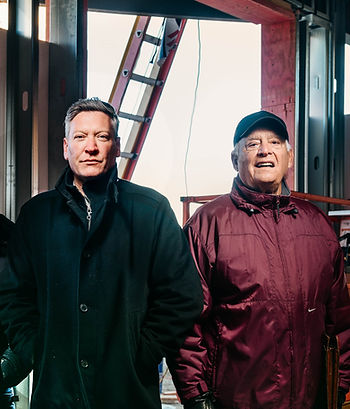
Romolo "Rom" Marsella played a major role in revitalizing downtown Providence. Key contributions include co-founding the Providence Foundation, establishing Urban Consultants and Marsella Development Corporation, and leading major projects like the creation of the Capital Center and the redevelopment of several historic structures in Providence. In 2008, his son Christopher became president of Marsella Development. In 2013, Chris established Marsella Properties, a full-service property management firm, which today manages approximately two million square feet of assets and provides a full range of services to private, academic and institutional clients. Both Rom and Chris have been active members of the community, serving on multiple non-profit boards and public commissions.
Chris and his family developed a $25,000,000 food hall at the historic Union Station complex, Track 15, which will be honored at this year’s Rhody Awards for Historic Preservation.
1. Marsella Development was instrumental in reviving downtown Providence starting in the 1970s. How did you first become interested in urban renewal and repurposing the city's historic assets?
(Rom) I joined the staff of the Providence Chamber of Commerce in late 1973 and was assigned to assist downtown retailing which had recently experienced the bankruptcy of the Shepard and Gladding department stores. Shortly thereafter, the Biltmore Hotel closed as well. The foregoing events and the apparent lack of any good news on the development front undermined the confidence level of both business and governmental leaders in the future of the city.
In the fall of 1974, in a surprising election, Vincent “Buddy” Cianci became mayor of Providence. By that time, my focus at the Chamber became more new development oriented rather than retail promotion. Initially, the relationship between the new mayor and the business community was negative and I found myself trying to bridge the confidence gap by successfully promoting several events that the mayor embraced, earning the trust of his administration.
Concurrently, the Chamber created the Providence Foundation to focus the business community’s interest in downtown development, and I became its first full-time employee ultimately becoming its Executive Director.
2. Among your many projects, you oversaw the rehabilitation of the Providence Performing Arts Center (PPAC) and Union Station. Tell us about the unique challenges and opportunities in repurposing these iconic buildings.
(Rom)
THE PROVIDENCE PERFORMING ARTS CENTER
I recognized early on that it was essential that the foundation focus on projects that could be implemented in short time frames and that required the participation of both private and governmental interests in order to succeed. Working with the highly regarded Antoinette Downing, Chair of the Rhode Island state historic preservation agency, we identified the saving of the former Lowes State Theater from demolition as an important goal. I raised private and public funds to coordinate a study which recommended its conversion into a Performing Arts Center. The effort generated a great deal of publicity which further cemented the relationship of the city, state, and business community. Less than one year after completion of the study and fundraising, the former movie theater reopened in October of 1978, fifty years after its original opening date. 97 years have passed since the theater first opened, and it has been transformed into one of the most successful venues of its type in the country. Equally important to saving the building and enhancing the arts offerings in our state, the successful partnership between business and government generated confidence that more could be achieved.
UNION STATION
As early as 1976, I began working with city, state and preservation interests to redevelop the Providence Union Station property. Built in 1898, the National Register property had fallen on hard times including the abandonment of four of the five buildings in the complex. Given the success of the performing arts center project, the Providence Foundation was given a leadership role in coordinating the effort to redevelop the properties. Following a number of false starts, I concluded that the only way to establish Union Station as the epicenter of the capital city, was to relocate the “Chinese Wall” of railroad bridges to a new location which enabled the extension of an expanded lawn to the historic State House. In a joint announcement with city, state, and federal authorities in the fall of 1978, we announced the creation of the Capitol Center project creating 13 parcels ready for development for office, hotel, residential, and retail uses. Today Capitol Center has come to represent the largest and most successful private-public endeavor in Rhode Island History. The historic Union Station development became the transition between the original downtown and the new development connecting to the State House.
3. You've recently transformed the lower level of Union Station into Track 15—a gourmet food hall. What led you to become both developer and manager of this property?
(Chris) My family has been involved with Union Station for nearly 50 years and through all its evolutions, the decline of the area from 2010-2020 was the most frustrating to watch. A lack of investment and lack of cooperation and planning among different owners led to an increase in vacancies and common areas losing their luster. Since we were only one of six owners of different buildings within the complex, we didn’t have a controlling voice, however we had a strong commitment to re-imagining the Station as there was such clear success over the previous 30 years. We knew we had to do something, and we saw the lower level of the RI Foundation Building (the former Capital Grille space and what still had Bar Louie in it next door) as the opportunity to bring life back to Union Station. We embarked on a plan to bring a food hall highlighting local cuisine to the space(s) with little knowledge on how to actually do that. Then Covid happened.
Five years later, we are operating a food hall in the center of the city. It has certainly been more than just a spark for Union Station and has brought renewed energy to downtown Providence that we could not have imagined. We are still making new plans each day for drawing people of all ages, particularly families with young kids, to not only enjoy the culture of Track 15, but to then explore this incredible city of ours.
4. What is unique about the business model for historic conversions vs. new construction? In your opinion, what is the best way to encourage more rehabilitation of historic structures vs. tear downs?
(Chris) Simply put – you can never recreate the authentic thing. We could have built the food hall in a new building on the edge of the parking lot at Union Station and in many ways it would have been easier and maybe even cheaper. However, the decision to go to the lower level of the historic passenger hall of Union Station not only gave us incredible design direction but also our branding, our personality, our entire story. That you can’t really fake, and I think the wonderful thing about Providence, and RI residents in general, is that they respect authenticity. There is something magical about recreating an entirely new use within a historic structure and giving it a 2nd chance. In this case, it’s like the 7th chance, but I can’t think of a better capstone to the building’s rich history.
5. What is your favorite historic spot in Rhode Island?
No joke. We both picked Southeast Lighthouse, Block Island. We have witnesses!